Snakes Around Florida Homes: The Species You’re Most Likely to See
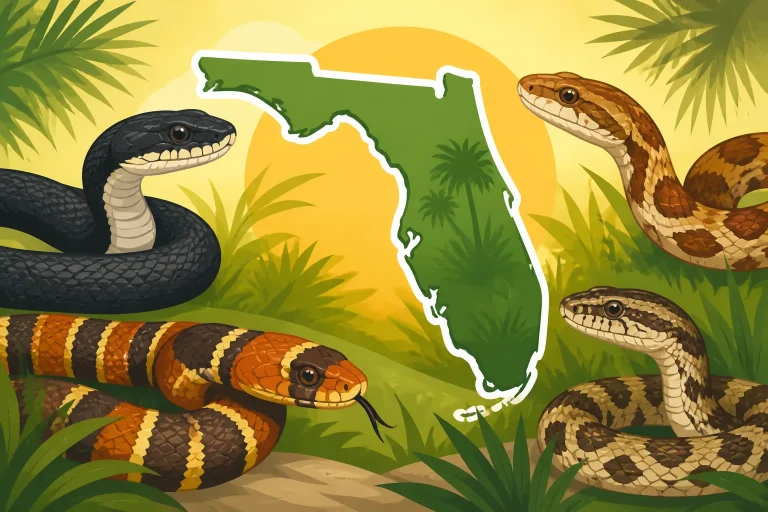
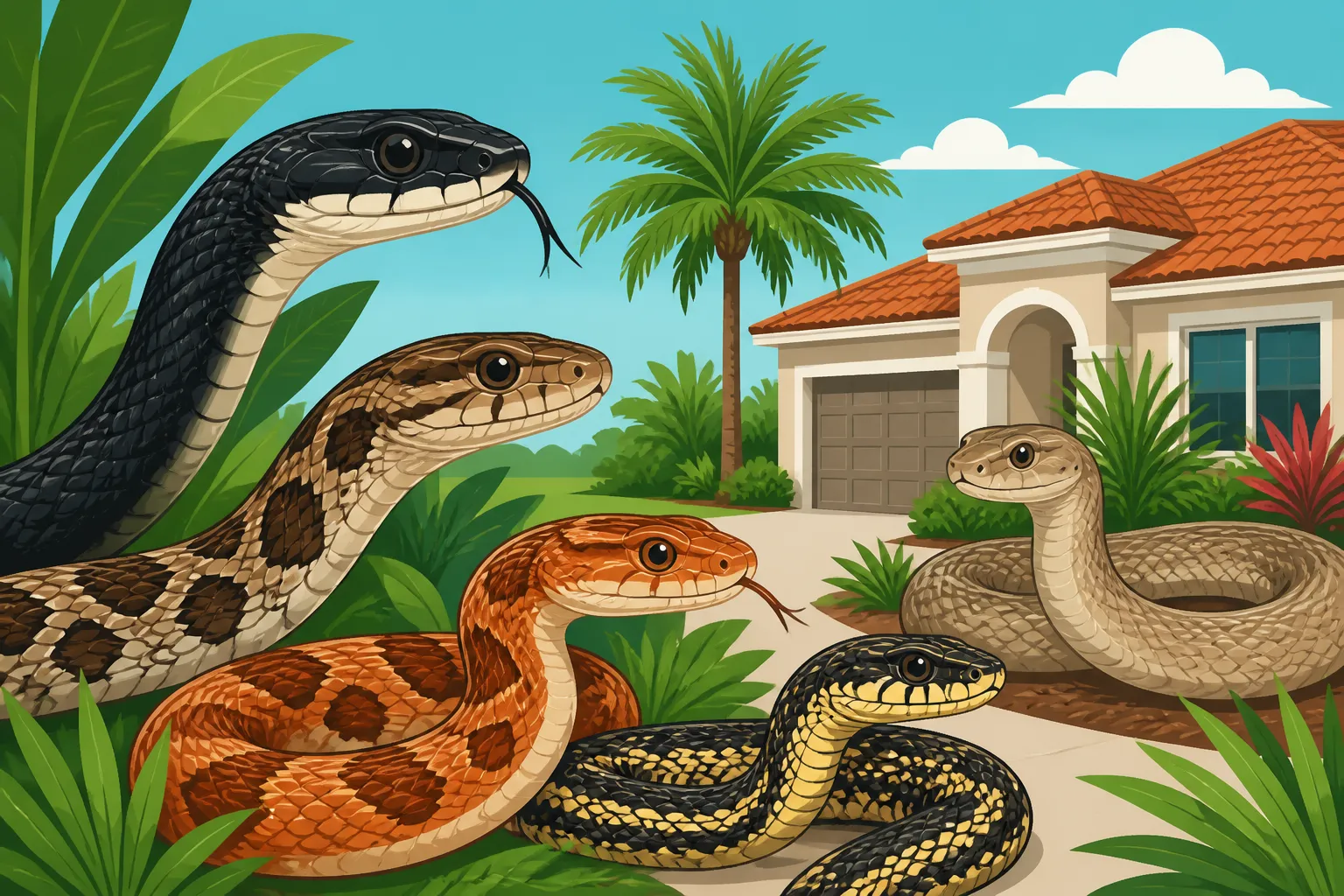
Florida homeowners can find a snake in a garden, beside a pool, in a garage, or near a doorway and have no idea what to do next. Several kinds may use residential yards, and some are difficult to distinguish at a glance. This guide explains which snakes you might encounter, how to respond from a safe distance, and what can make a yard less inviting.
Why snakes turn up around Florida homes
A snake near a house is often there because the yard offers something it needs: shelter, a place to rest, or prey. A garden, woodpile, shed, dense groundcover, or gap beneath a structure can provide places to hide. Rodents, frogs, lizards, and other small animals may also attract snakes to an area. A sighting does not necessarily mean a snake has moved indoors or settled permanently.
The Florida Fish and Wildlife Conservation Commission says many species thrive in residential areas. That does not mean every species is equally likely to appear in every neighborhood. Local habitat matters: a home near a wetland, wooded area, field, or pond may have different visitors from a home in a densely developed area. Even within the same neighborhood, landscaping and available cover can vary from property to property.
Florida has 50 species of native snakes, according to the Florida Fish and Wildlife Conservation Commission. With that variety, an unfamiliar snake may be hard to identify from a quick look, especially if it is moving, partly hidden, or seen in poor light. A photo taken from a safe distance can be useful, but getting closer to improve it is not worth the risk.
Snakes are not always found in obvious wild spaces. A snake may pass through a yard, shelter beneath a deck, or use cover near an outbuilding. That does not necessarily mean the property is unusually attractive to snakes. It may simply offer a route between hiding places or a suitable spot to rest.
The useful first question is not “How do I get rid of every snake?” It is “Where is it, and can people and pets keep away from it?” For a snake outdoors, distance and a clear route away from the animal are often the simplest starting points. If it is inside, near a frequently used entrance, or in a place where someone could accidentally approach it, keep people and pets away and consider getting professional help.
A single sighting can also point to a fixable yard condition. Repeated sightings may justify checking for clutter, accessible shelter, and food sources such as rodents. They do not prove that a snake is living on the property. For more on possible attractants, see Why Snakes Keep Showing Up Around Your Florida Home.
Snakes and snake groups you may encounter
There is no reliable way to name a snake from its location alone. A snake near water might be a water-associated species, but location is only one clue, and different kinds can use the same general habitat. Color and pattern help narrow possibilities, yet they can vary with age, lighting, and the individual snake. Keep your distance even if you think you recognize it.
The table below offers broad starting points, not a way to decide that a snake is safe. It describes kinds of snakes that may be encountered around Florida homes without claiming that any one is the most common across the state.
| Broad kind of snake | What you might notice from a distance | Why identification can be tricky |
|---|---|---|
| Rat snake | A relatively large snake that may have a pattern or appear darker as an adult | Appearance can change with age, and other snakes may also be patterned or dark |
| Racer | Often looks slender and quick-moving, and may appear dark | A dark, narrow body alone cannot confirm an identification |
| Garter or other striped snake | Stripes can be visible along the body | Stripes are not unique to one kind of snake |
| Water snake | May be seen near a pond, canal, or other water | Water-associated snakes can look similar to one another, and location does not settle the identification |
| Cottonmouth | A venomous snake associated with wet habitats that may also be encountered around yards | Its appearance and posture can be misread, and getting close to check features is unsafe |
| Rattlesnake | Some species have a rattle at the tail; the animal may be patterned | A visible rattle is not a feature to approach or search for |
| Coral snake | A banded snake with a distinctive color pattern | A quick glimpse may not show enough detail to distinguish it confidently from other snakes |
A rat snake or racer may look intimidating simply because it is large or moves quickly. That does not make a guess based on body size or movement dependable. Smaller snakes can also be hard to identify because their markings may be faint or obscured by leaves, mulch, or shadows.
Snakes seen near water are another frequent source of confusion. Several kinds may use wet places, and a snake on a bank or near a pool is not automatically a cottonmouth. Do not try to distinguish a water snake from a venomous look-alike by walking closer, using a stick, or provoking it to move. The article Cottonmouth or Water Snake? What FWC Says to Look For discusses why the comparison can be difficult without approaching the animal.
Some Florida snakes are venomous, and some nonvenomous species resemble them in ways that can fool a casual observer. Head shape, body thickness, color, and pupils are not reliable shortcuts for making a safe decision. Treat an unidentified snake as one to avoid, rather than testing a visual rule. Venomous or Not? How to Tell Florida Snakes Apart Safely offers more on the limits of quick comparisons.
The broad groups in the table are not a complete species list, and they are not a checklist for deciding whether a snake can be handled. A reliable identification needs enough clear information to assess the animal as a whole. If that cannot be done from a safe distance, leave the identification to a qualified professional or wildlife agency.
How to assess a sighting without getting closer
Start with the snake’s location, not its markings. If it is outdoors and no one is near it, ask whether people and pets can stay away while it moves on. If it is near a path, play area, doorway, or work space, keep others back and use another route. Do not corner it or try to make it leave.
If you want to record what you saw, note general details from where you already are: where the snake was, whether it was near water or cover, and what its overall appearance looked like. A photo is optional. Do not approach, block its path, lift an object it is hiding under, or reach into vegetation to get a better view. Even a clear picture is not worth creating a close encounter.
The Florida Fish and Wildlife Conservation Commission (FWC) recommends standing back and observing; residents can figure out what kind it is by using these resources: its Snake Identification, Commonly Encountered Snakes, and Guide to Florida’s Venomous Snakes. Use identification resources to compare what you can see from a safe distance, not as a reason to get closer or handle the animal.
Try not to rely on a single feature. A snake’s color can look different in shade or sunlight, and a pattern can be partly hidden when its body is coiled or covered. A fast glance may not show the head, tail, or full body. Even a combination of visual clues may leave uncertainty, particularly when the snake is moving or visibility is poor.
If the animal is difficult to see, the right response is still to keep your distance. You do not need to identify a snake before taking sensible precautions. For help narrowing down an uncertain sighting, see Narrowing Down a Mystery Snake by Region, Color and Pattern. If there is a potential safety concern, avoid relying on a photo or a guess to decide that it can be approached.
A useful way to think about identification is to separate “what it may be” from “what I should do.” You can be unsure of the species and still make a safe choice: keep people and pets away, avoid handling it, and get help if the situation calls for it. No visible feature makes an unidentified snake safe to touch.
What to do when you find one in the yard or house
For a snake outdoors, calmly create space. Bring children and pets indoors or keep them well away, and avoid surrounding the snake. If there is a clear path for it to move away from the area without passing close to anyone, give it room. Do not try to pick it up, pin it down, or kill it.
When the snake is in a part of the yard that people can avoid, it may be possible to leave the area undisturbed and let it move on. If it is near a door, a busy path, or a place where children play, use a different route and keep that area off limits. The aim is to prevent an accidental close encounter, not to force the snake into moving before it is safe.
An indoor sighting needs more care because the animal may be in a confined space or near someone’s usual path. Keep people and pets out of the room, and do not reach behind furniture, lift boxes, or try to chase the snake out. If it disappears, avoid searching in places where it may be hidden. Consider contacting a qualified professional who can advise on the next steps. See Snake Inside the House in Florida? Steps From a Safe Distance for practical guidance about an indoor sighting.
A snake in a garage, shed, or other outbuilding can be hard to assess because clutter creates places to hide. Keep your distance and do not move stored items to look for it. If the animal can be left undisturbed while people avoid the area, that may reduce the chance of contact. If you cannot safely keep others away or the snake is difficult to leave alone, seek professional help. Snake in the Garage or Shed? Why Opening the Door Often Works covers one type of situation without making handling the animal necessary.
If you are unsure what kind of snake you are seeing, keep your distance and contact a professional or the wildlife agency. Use the agency’s official website to find current contact information. Do not try to capture or transport an unidentified snake, even if it seems injured or appears to be blocking access.
If a person is bitten, treat it as a medical emergency and call 911 or Poison Help at 1-800-222-1222. Do not delay getting help while trying to identify the snake. For further reading, see Snakebites in Florida: The First Steps That Matter and After a Snakebite in Florida, Leave the Snake: Here’s Why.
Florida’s laws about snakes and wildlife can depend on the animal and the action someone is considering. Do not assume it is legal to kill, move, capture, or release a snake based on a rule from somewhere else. Check current official guidance before taking action. What Florida Law Says About Killing, Moving and Protected Snakes provides a starting point for understanding why it is important to check the rules.
Make a yard less inviting without putting yourself at risk
The most practical prevention work is usually about making a property easier to inspect and reducing places where prey and snakes can hide. These steps do not guarantee that a snake will never enter the yard. They can, however, make it easier to spot activity and reduce some conditions that may attract wildlife.
Reduce hiding cover near the house
Keep areas beside commonly used paths and doors as clear as practical. Dense groundcover, piles of lumber, stacked materials, and untrimmed growth can make it harder to see what is present. Before moving stored materials or reaching into a concealed space, look from a safe position and use caution. A snake may be under or beside something that has not been disturbed for a while.
Store firewood and yard materials neatly rather than leaving them scattered. Keep storage areas organized enough that you can see the floor and avoid reaching blindly between objects. If an item needs to be moved and a snake may be nearby, do not use your hands to investigate beneath it.
Check spaces around sheds, decks, and other structures for clutter that creates sheltered spots. Do not crawl under a structure or reach into a gap to see what is inside. If inspection or repair would put you close to a hidden animal, seek help rather than probing the space yourself. The article Snake-Proofing a Florida House: Gaps, Debris and Food Sources expands on prevention around structures.
Address likely food sources
Rodents and other small animals can provide food for snakes. Keep garbage and food waste secured, and avoid leaving pet food outside when it is not needed. Store birdseed and similar supplies so they do not spill or remain accessible to wildlife. If you see signs of rodents, address that problem rather than trying to control snakes alone. Rats in the Garage or Shed? Why Snakes May Follow explains why a prey animal can be part of the picture.
Removing every snake is not a reliable way to solve a rodent issue. Wildlife use many routes and sources of food, and another animal may eventually move into the same habitat. Cutting down on accessible food, shelter, and entry points is more useful than treating every sighting as a standalone problem.
Make everyday outdoor checks safer
Before mowing, gardening, or clearing debris, pay attention to the area around your feet and hands. Wear suitable footwear for the task, and do not put a hand into a hole or beneath an object you cannot see around. If a snake appears while you are working, stop and move away rather than trying to finish the job around it.
Keep children’s play spaces and frequently used paths free of avoidable clutter. Before a child enters an area where a snake was just seen, check that the snake is no longer there from a safe distance. Teach children to stop, move away, and tell an adult rather than approaching or trying to scare the animal.
Pets should also be kept away from a snake. Do not let a dog or cat investigate, bark at, paw, or chase it. If a pet has had contact with a snake, contact a veterinarian for advice. The article Dog Owners’ Guide to Venomous Snakes in Florida discusses why distance matters for pets as well as people.
When to get help and how to avoid a repeat surprise
A professional may be useful when a snake is indoors, is in a place that cannot be kept safely off limits, or cannot be left undisturbed without creating a safety concern. Professional help can also make sense when the animal’s identity matters for deciding what to do next and it cannot be identified from a safe distance. Choose a qualified professional, and use official agency guidance to understand available local options.
If you contact a professional or wildlife agency, explain where the snake is and whether anyone or any pet is at risk. Share a photo only if it was taken without approaching the animal. Do not try to catch the snake so you can deliver it for identification. If there is uncertainty about the species, say so instead of guessing.
Repeated sightings are a reason to review the property, not proof that one snake has taken up residence. Look for changes that could be contributing to the encounters: new debris, storage that blocks sight lines, rodent activity, or a gap into a building. If sightings keep occurring in a location where people must pass, get advice about the specific site rather than attempting a risky removal. Repeated Snake Sightings by the House? Look for Rodents covers one possible clue, but a local assessment may be needed to understand the full situation.
Keep a record of where and when you notice snakes if repeated encounters are becoming a concern. You might note whether the sighting was near water, a structure, or a pile of material. These observations can help you recognize a pattern without requiring you to approach the animal. They are not a substitute for identification or a reason to set a trap.
If an animal appears injured, trapped, or unusually difficult to avoid, do not handle it. Contact the appropriate wildlife agency or a qualified professional for guidance. If the snake is in a place where people can safely stay away, leave it undisturbed while you seek advice. Follow current official instructions about wildlife rather than relying on assumptions about what may be moved or released.
The safest goal is not to become an expert from a brief glance. It is to recognize when a snake is present, keep people and pets away, and avoid actions that bring anyone closer. A clear route, an undisturbed animal, and a call for qualified help when needed are often better than an improvised attempt to capture or identify it.
Frequently Asked Questions
Are snakes around Florida homes unusual?
No. Florida has many native snake species, and some use residential habitat. A sighting can happen even when a yard is maintained; it does not by itself show that a snake lives there.
Can I tell whether a snake is venomous from its head shape?
Do not rely on head shape alone. Appearance can be misleading, and getting close to check a feature is not safe. Keep away from an unidentified snake and seek qualified help if the situation requires it.
Should I move a snake out of my yard?
Do not try to capture or move an unidentified snake. Keep people and pets away, and check current official guidance or contact a qualified professional if it cannot be left undisturbed safely.
What if I cannot get a clear photo?
A photo is not necessary for keeping your distance. Note where the snake is and avoid approaching it. If identifying it is important for deciding what to do, contact a professional or wildlife agency.
Sources
- Florida Fish and Wildlife Conservation Commission — Living with Snakes (checked November 20, 2026)
Disclaimer
This article is for general informational purposes only and does not constitute professional advice. Laws, prices and regulations vary by location and change over time. Consult a qualified professional for guidance on your specific situation. Florida Critter Guide is not a government agency or pest control company and is not affiliated with any government agency.