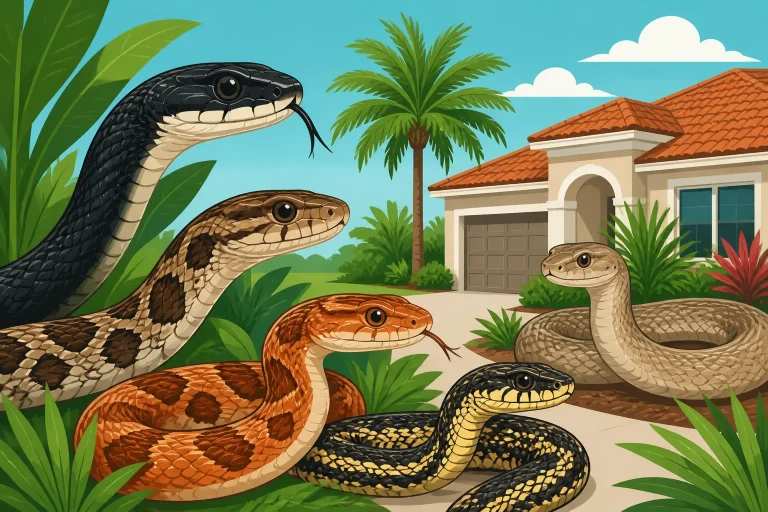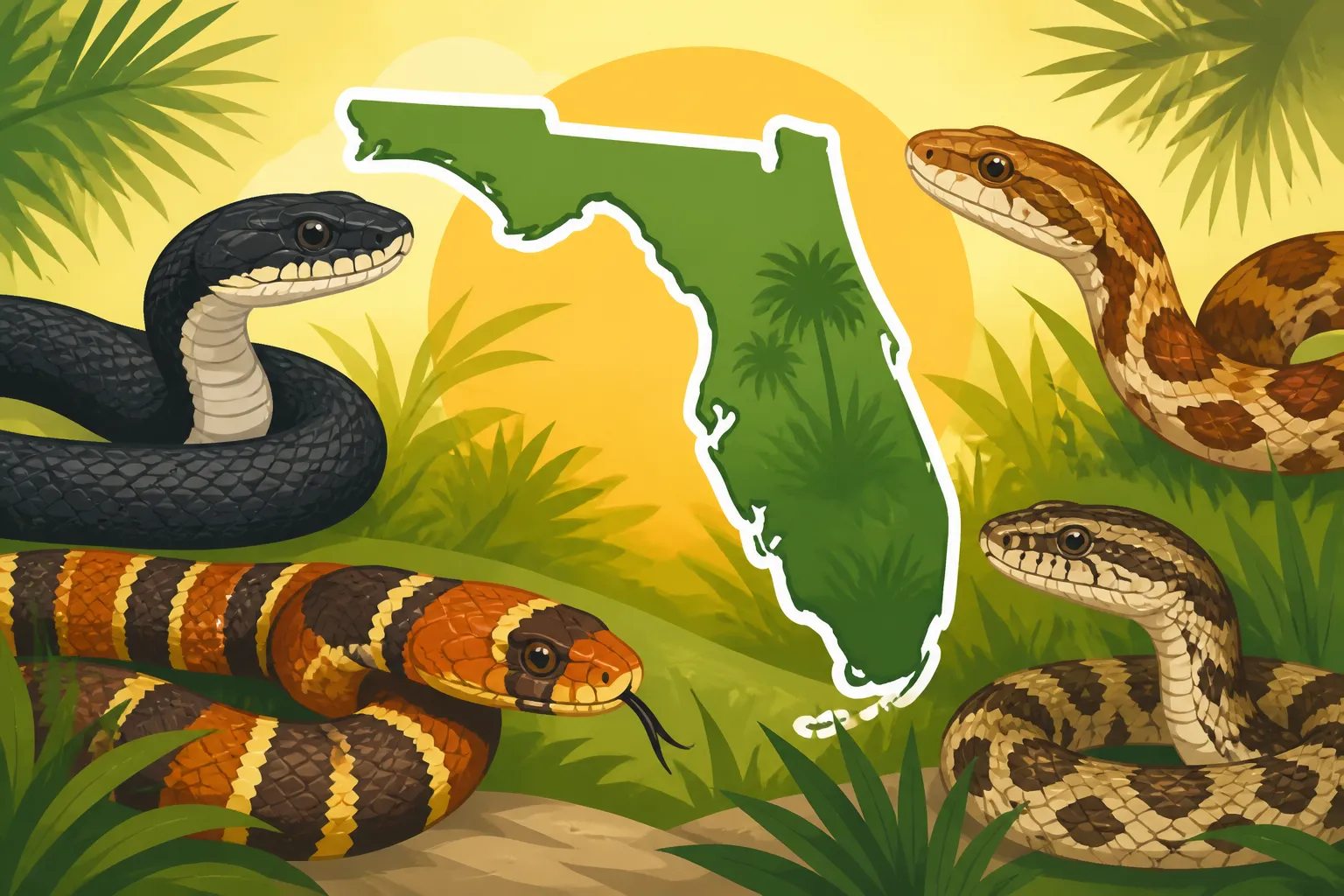
Florida Snake Identification: Pictures, Regions and Patterns
Finding a snake in a Florida yard can make it tempting to identify it quickly from a photo, its color, or the shape of its head. Those clues can help, but none should be treated as proof on its own. This guide explains how to observe a snake safely, use region and pattern to narrow possibilities, and check an identification without getting closer.
Start With Distance, Not a Guess
The safest way to identify a snake is to observe it without approaching or disturbing it. Keep children and pets back, give the snake room to move away, and avoid trying to touch, trap, kill, or move it. Even a clear-looking snake may be hard to identify from a quick glance, and appearance alone is not a safe basis for deciding how to handle it.
The Florida Fish and Wildlife Conservation Commission (FWC) recommends standing back and observing, and says you can figure out what kind it is by using these resources: Snake Identification, Commonly Encountered Snakes, and Guide to Florida’s Venomous Snakes. The resources can help when a snake is near a home or play area, but the first step remains keeping your distance.
Florida has 50 species of native snakes, according to the Florida Fish and Wildlife Conservation Commission. A broad range of species, variations in appearance, and similar-looking snakes can make a confident identification difficult from one feature or a single photograph. A useful process is to gather several observations from a safe place, then compare the complete set of clues with a reliable reference.
If you cannot identify the snake, do not try to settle the question by moving closer. Keep away and contact a professional or the wildlife agency for guidance. For help with a snake that remains near a home, see Who Removes a Snake in Florida? Trappers, FWC and Your Options. If someone is bitten, call 911 or Poison Help at 1-800-222-1222.
What to notice from a safe place
Before opening a field guide or searching photos, take a moment to record what you can see without approaching. Useful observations include:
- Where it is: Note the general area, such as a yard, building, path, roadside, or waterside. Do not enter brush, step over obstacles, or reposition yourself to get a better view.
- What it is doing: Is it still, moving away, climbing, or partly concealed? A snake’s position may affect which parts of its body are visible.
- Its general size: If you can judge this from where you are, record an approximate description rather than trying to measure it.
- Its overall color: Use broad terms such as brown, gray, black, reddish, yellowish, or greenish. Lighting and shadows can alter how a color appears.
- Its pattern: Notice whether the body looks mostly uniform, striped, banded, blotched, or speckled. Record what you see rather than trying to name a species.
- Visible details: If the head, tail, or body markings are already in view, note them. Do not wait for the snake to turn or move into a more exposed position.
It is fine if some details are missing. A partial view is not a reason to approach. A safe, incomplete observation is better than a closer look that could disturb the snake.
Use Region as a Clue, Not a Conclusion
Florida’s geography can help narrow a search, but a map should be treated as a filter rather than a final answer. A location may make certain possibilities more relevant than others, yet location alone does not confirm an identification. Snakes move through connected landscapes, and a residential sighting may not occur in the kind of habitat a person expects.
The Florida Museum of Natural History provides a tool for filtering results based on the region you saw the snake and its main color or pattern. That can make a long list of possibilities easier to manage. Start with the broadest location you can describe accurately, then combine it with visible traits. Do not treat the first result as a confirmed match.
Record the location without overinterpreting it
A useful location note is specific enough to guide a search but does not assume the snake belongs to a particular habitat. For example, you might record that it was near a house, beside a path, around a wet area, or in a patch of vegetation. If you know the general part of Florida, add that as another clue.
The location can matter even when the snake is not in a natural-looking setting. Many species thrive in residential areas, according to the Florida Fish and Wildlife Conservation Commission. A sighting near a garage, garden, lawn, or other developed space does not by itself identify the snake or establish where it came from.
Be cautious about assumptions such as “a snake near water must be a water snake” or “a snake in the yard must be a common yard species.” The place where you notice an animal may be only one part of its surroundings. A snake can also be partly hidden, making it difficult to see whether it is near a particular habitat feature.
For more context about where snakes may be encountered, From Mangroves to Dry Uplands: Where Florida’s Snakes Live and Snakes Around Florida Homes: The Species You’re Most Likely to See provide useful starting points. A habitat match can help you decide which references to check; it should not replace comparing the snake’s visible features.
Let location narrow the list, then check the body
A region-based search is most useful when it reduces a large set of possibilities to a manageable group. After that, compare the candidate snakes against the details you actually observed:
- Does the overall color match, allowing for shade and lighting?
- Does the pattern continue along the body in a similar way?
- Are the markings in the same places and arranged similarly?
- Does the reference show a similar overall body appearance?
- Are the features you need to compare actually visible in your observation?
If a useful feature is hidden, do not fill in the blank by guessing. The right result may remain uncertain until a qualified person can assess the sighting. An identification tool can suggest possibilities; it cannot make an obscured mark visible or turn an unclear photo into a definitive record.
Read Color and Pattern Together
Color is often the first thing a person notices, but it is also one of the easiest details to misread. Sunlight, shade, wet surfaces, reflections, distance, and phone-camera settings can all affect how a snake appears. A color that looks bright in a photo may have looked muted in person, and a dark body may hide markings that are easier to see in better light.
Pattern gives color more context. Rather than stopping at “brown snake” or “black snake,” note how the color is arranged: Is it mostly even? Are there lighter or darker bands? Are there blotches along the back? Is there a stripe, or small marks repeated across the body? These descriptions are more useful for comparing references than a single color label.
| Observation | How it can help | What it cannot confirm |
|---|---|---|
| Overall color | Narrows a search when combined with other visible features | A species by itself |
| Bands or crossbands | Helps compare the placement and shape of markings | Whether a snake is venomous |
| Blotches or saddles | Helps distinguish patterns that may look similar at a glance | An exact identification from a distant view |
| Stripes | Adds detail about how color is arranged along the body | That a particular name or group is correct |
| Speckles or small marks | Helps describe a repeated pattern in a photo or note | A match if the marks are blurred or obscured |
| Mostly uniform appearance | Helps separate a plain-looking body from a strongly patterned one | That markings are truly absent; lighting may hide them |
Describe the pattern before naming it
Pattern words are useful because they record what you see without jumping to a conclusion. A band is a band-like marking across the body; a blotch is a larger, separated patch; a stripe runs along the body; and speckling describes smaller marks. These are visual descriptions, not guarantees that a snake belongs to a particular species.
It can help to write down where the markings appear. Are they visible along the back, on the sides, or across much of the body? Do they look evenly repeated, irregular, or broken up? Can you see the pattern on the tail, or is the tail hidden? These details may help when comparing a photo to an identification reference.
Patterns may also seem different as the snake moves or curls. A body that is partly folded can make a continuous marking look broken, while overlapping sections can hide the spacing between marks. Record what is visible at the moment rather than trying to infer the unseen parts.
Do not rely on one dramatic feature
A striking color, bold band, or unusual mark may draw attention, but it should not carry the whole identification. Similar colors can occur in different snakes, while the same general pattern category can include snakes that are not close matches in other ways. A search result based on one memorable feature may therefore create false confidence.
The same caution applies to online photographs. Images may be taken in different light, from different angles, or at different stages of a snake’s life. A photo can make a snake’s colors look stronger or its body markings look sharper than they appeared in person. Compare the full visible pattern and overall appearance, not just the feature that caught your eye.
For help distinguishing similar-looking snakes, see Venomous or Not? How to Tell Florida Snakes Apart Safely and Comparing Look-Alikes Without Getting Close to the Snake. They can support a careful comparison, but they are not a reason to approach a snake for a better view.
Compare the Whole Snake, Not Just Its Head
It is common to search for a quick visual shortcut, especially when the snake is unfamiliar. But a single feature should not be used to decide whether a snake is harmless or venomous. Head shape, color, pattern, and other visible traits can be difficult to judge at a distance, and an angle, shadow, or defensive posture can change how a feature looks.
Instead, compare the whole set of visible clues. Consider the body pattern, general color, location, and what is visible of the snake’s shape. Then check whether more than one reliable reference supports the same possibility. If a resource uses features you cannot see, mark those details as unknown instead of assuming they fit.
Why quick rules can mislead
A short rule or rhyme may sound easier than comparing a full description, but it can leave out look-alikes and the limits of what can be seen in the field. A snake may be partly hidden, turned away, or viewed in poor light. A feature that appears clear from one angle may be unclear from another.
The safest approach is to treat every visual trait as a clue, not a safety test. Do not decide that a snake is safe to approach because its head looks narrow, its colors look familiar, or its body resembles an image online. If you cannot confidently identify it from where you are, keep your distance.
For a focused explanation of one often-used shortcut, Can Head Shape Alone Tell You a Florida Snake Is Venomous? discusses why head shape alone is not enough. For another commonly repeated claim, Relying on Coral Snake Rhymes: What UF/IFAS Says offers context about why a rhyme should not substitute for a careful identification.
Venomous-snake references are for comparison, not handling
Florida’s venomous-snake resources can help readers understand what to look for, but they do not make close observation necessary. Use an official guide from a safe location, compare the snake only with features that are visible, and stop if the match is uncertain.
If the snake may be venomous, act as though getting close could be dangerous. Keep other people and pets back, do not attempt to catch or kill it, and seek help from an appropriate professional or wildlife agency. Identification can wait until the snake is no longer an immediate concern.
If a bite occurs, call 911 or Poison Help at 1-800-222-1222. Do not approach the snake to take a photograph or capture it for identification. Do You Need to Identify the Snake After a Bite in Florida? explains why a person should not make collecting the snake part of the response.
Take Useful Pictures Without Getting Closer
A photograph can be helpful when it is taken from a safe distance without changing the snake’s behavior. It is not worth moving toward the snake, blocking its path, shining something at it, or trying to make it raise its head. If you cannot take a clear picture from where you are, rely on your written observations instead.
A useful photo should show as much of the visible snake as possible while preserving a safe distance. If the snake is partly covered by leaves, a wall, or an object, do not move the obstacle. If it is leaving, let it go rather than following it for a better angle.
Make the photo a record, not a close-up
If safe and practical, take a picture from the place where you are already standing. Avoid using a photo as a reason to crouch near the snake, step into dense vegetation, or cross a barrier. Use the camera’s existing zoom if available, but do not assume a zoomed image will show every feature accurately.
Take more than one image only if doing so does not require approaching or drawing the snake’s attention. A view of the body and its visible pattern may be more useful than a tightly cropped head image. Include enough of the surroundings to remember the general setting, but avoid revealing private details when sharing the image publicly.
The photo can be paired with notes about the general region, habitat, time of observation, and which features were visible. Keep those notes factual: “dark back with lighter blotches visible” is more useful than “definitely a particular snake” if the identification has not been confirmed.
For more guidance on what an identification photo can show, see Finding Good Photos to Identify a Florida Snake. If an image is blurry, distant, or obstructed, it is better to say so than to treat the picture as conclusive.
Avoid unsafe photo-taking habits
Do not put a hand, foot, or object near the snake to give the camera a size reference. Do not try to flip, restrain, or reposition it. Do not corner it against a wall or container for a better picture. Those actions can expose you to a bite and may prevent the snake from moving away.
Also avoid relying on a photograph that shows only a small part of the animal. A close crop of a head or tail may omit markings and body features needed for comparison. If the snake is gone before you can take a picture, that is not a problem. A careful description from a safe distance can still help narrow possibilities.
Use Identification Tools Carefully
A good identification process is a comparison, not a race to name the snake. Start with a broad reference, record what matches and what does not, and keep uncertainty visible. If two possible results both seem plausible, the most useful conclusion may be that the snake has not been identified yet.
The Florida Museum of Natural History’s region and color or pattern filters can help you narrow the list. FWC’s Snake Identification, Commonly Encountered Snakes, and Guide to Florida’s Venomous Snakes resources can provide additional comparisons. Use these references to check an observation, not to justify moving closer or handling the animal.
A practical identification sequence
- Move to a safe position. Give the snake space, keep others back, and do not approach for a better look.
- Write down the location. Record the general part of Florida and the setting where you noticed it.
- Describe what is visible. Note the overall color, pattern, and any other visible details without guessing about hidden features.
- Use a regional search to narrow the options. Treat the results as possibilities, not a verdict.
- Compare the complete visible pattern. Check whether the reference matches more than one detail, not just the color or one mark.
- Stop if the evidence is unclear. Keep your distance and contact a professional or the wildlife agency if you need help.
That sequence helps prevent a common mistake: choosing the first image that resembles the snake and then interpreting every other clue to fit it. It is reasonable to consider more than one possibility. It is not reasonable to resolve uncertainty by getting closer.
Cross-check differences as well as matches
When comparing a snake with a reference, look for details that do not fit. If the color seems similar but the pattern is different, note the difference. If the picture shows a feature that you could not see, do not count that as a match. A result that fits one visible trait but conflicts with others should remain uncertain.
If your candidate list includes several similar snakes, compare them one at a time. Look for the differences that a reliable guide highlights, but only use those differences if they are visible from your safe position. A guide may contain close-up images or precise details that are impossible to judge in a distant sighting. That does not mean you should try to get a closer look.
For a broad overview, Snakes in Florida: A Guide to the State’s Native Species can help put an observation in context. If a snake is near a home, What to Do When You Find a Snake in Your Florida Yard focuses on the practical response while you keep your distance.
When the Snake Is Near a Home, Path, or Play Area
A snake’s location may make the encounter feel more urgent, but the response still starts with separation. Keep children and pets away, avoid surrounding the snake, and leave it an open route to move off if it chooses. Do not try to guide it with a broom or other object if doing so would bring you closer.
If the snake is outside and moving away, there may be no need to do anything beyond keeping people and pets back until it has left the area. If it remains near a doorway, play area, or other place people need to use, do not attempt to handle it yourself. A trained professional or wildlife agency can advise on the next step.
For an indoor sighting, do not reach behind furniture or objects to locate the snake. Keep people and pets out of the room if you can do so safely, and avoid blocking yourself in with it. Snake Inside the House in Florida? Steps From a Safe Distance covers the basic considerations for an indoor encounter, and When an Indoor Snake Is a Job for a Nuisance Wildlife Trapper can help you think through when to seek professional assistance.
An identification is useful, but it is not the only issue. If the snake is in a place where a person or pet could accidentally encounter it, prioritize distance and professional guidance rather than trying to complete a photo-based identification yourself.
Frequently Asked Questions
Can I identify a Florida snake by color alone?
No. Color is a useful clue, but lighting, shadows, distance, and variation can affect how it appears. Compare color with the snake’s pattern, location, and other details that are visible, and keep your distance if you are unsure.
Does a snake’s location tell me what it is?
Location can help narrow the possibilities, but it does not confirm an identification. A snake may be seen in a residential area or in a setting that does not match your expectations. Use region as one clue alongside visible features.
Should I get closer to take a clearer picture?
No. Do not approach, handle, corner, or move a snake for a photograph. Take an image only from a safe place; if that is not possible, use written observations or leave the identification unresolved.
What should I do if the snake cannot be identified?
Keep your distance and contact a professional or the wildlife agency for help. Do not treat uncertainty as a reason to touch or move the snake. If someone is bitten, call 911 or Poison Help at 1-800-222-1222.
Sources
- Florida Museum of Natural History — Florida Snake ID Guide – Florida Museum of Natural History (checked November 19, 2026)
- Florida Fish and Wildlife Conservation Commission — Living with Snakes (checked November 20, 2026)
Disclaimer
This article is for general informational purposes only and does not constitute professional advice. Laws, prices and regulations vary by location and change over time. Consult a qualified professional for guidance on your specific situation. Florida Critter Guide is not a government agency or pest control company and is not affiliated with any government agency.